
Starting a business today is very different from starting one ten years ago. Technology has changed the way people work, sell, and grow. One of the biggest changes is the rise of AI and automation. These tools help business owners save time, reduce costs, and work smarter instead of harder.
If you are planning to start a business, this guide will show you how to use AI and automation the right way. You will learn what tools to use, how to apply them in different parts of your business, and how to grow faster with less effort.
Table of Contents
What Do AI and Automation Actually Mean?
These two words get mixed up a lot, but they are different.
Automation follows fixed rules. You tell it what to do, and it does the same thing every time. For example, sending a reminder email three days after someone leaves items in their cart.
Artificial intelligence (AI) makes judgments based on patterns. It looks at what happened before and makes a smart guess. For example, reading a receipt and working out which numbers are the total and the tax.
Most business tools today use a mix of both. You don’t need to know which is which. You just need to know where to use them first.
Why New Businesses Need This From Day One
When you start a business, time is your most limited resource. Every hour spent typing data, replying to the same questions, or checking spreadsheets is time you could have used to help customers or grow your business. AI and automation solutions take over this repetitive work, so you can focus on what actually grows the business.
Where to Start: Core Business Areas
Finance and Bookkeeping
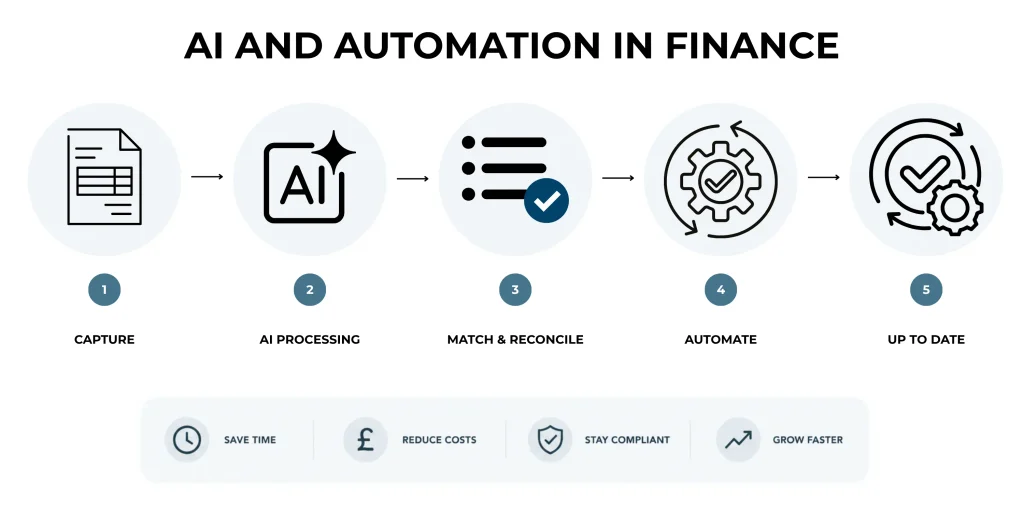
This is usually the best place to begin. Cloud accounting software now uses AI to read receipts, sort transactions, and match bank payments automatically. Automation handles the boring parts too, like sending invoices and payment reminders on schedule.
For UK founders, this matters even more because of Making Tax Digital rules, which require digital records with no manual copy-pasting between systems. Getting this right early saves a lot of pain later. For a clear, UK-focused look at where these tools save real time, and where mistakes tend to happen, the Accounting Wise guide to AI and automation for small businesses is worth reading, especially the section on VAT errors caused by automated software.
AI and Automation in HR
Even a business with just two or three staff can benefit from AI and automation in HR. Software can screen job applications and rank candidates in seconds. Onboarding tasks, like sending contracts and setting up accounts, can trigger automatically when someone accepts a job offer. Payroll software calculates pay, tax, and pension contributions, then sends the required reports without you touching a spreadsheet.
Customer Service and Sales
AI chatbots can answer common customer questions any time of day, and only pass on the harder questions to a real person. On the sales side, AI can score which leads are most likely to buy, and automatically send them the right follow-up message. Automation takes care of the repeat tasks, like updating your customer records or sending a reminder email at the right time.
Marketing
AI tools can write first drafts of blog posts, social media captions, and product descriptions, which you then check and improve. This cuts down the time from idea to finished post by a lot. Automation tools handle scheduling, like posting content at the best time or sending a discount code exactly a week after someone signs up.
AI and Automation Services for Business Process Improvement
As your business grows, you may want to look at AI and automation services for business process improvement. These are tools or experts who look at how your business works and find the steps that can be connected and automated. This becomes important once you’re using several different tools, because gaps start to appear like a customer sign-up that never makes it into your accounting system. Tools like Zapier, Make, or n8n exist to connect your different apps so information moves between them without you doing it by hand.
Suggested: Accounting Automation Software: Automate 80% of Your Tasks Easily
How to Choose the Right Tools
There are hundreds of AI and automation tools out there, and it’s easy to pick the correct ones. Here’s a simple way to choose:
- Find your real problem first. Spend two weeks noting where your time actually goes before buying any tool.
- Start with the task you repeat the most. This is where automation saves the most time.
- Pick tools that connect to each other. A tool that can’t share data with your other systems just creates more manual work.
- Always check the output, especially for money or customers. AI can draft and automation can act, but a human should still check the important stuff, at least at the start.
- Review your tools every few months. What works for a business with two customers may not work with two hundred.
Final Thoughts
The businesses that get the most out of AI and automation don’t chase every new tool. They pick one or two problem areas, set things up properly, check the results for a while, and then expand. Start with finance or customer service, since these usually have the most repeat work, and grow your automation from there. Done well, these tools let a small team move as fast as a much bigger business, which is exactly the edge a new business needs.
Frequently Ask Questions
How to start an AI automation business?
Start by choosing a niche and identifying common business tasks that can be automated. Then, use reliable AI and automation tools to build solutions, test your services, and gradually grow your client base.
Is AI and automation expensive for small businesses?
Not anymore. Many AI and automation tools offer affordable plans, making it easy for small businesses and startups to get started without a big budget.
0 Comments