
Most finance teams didn’t choose to fall behind on technology. It happened gradually, one manual invoice and one late-night reconciliation at a time, until suddenly the whole department was buried in work that software should have handled years ago. In 2026, that gap is becoming harder to ignore, and harder to afford.
Businesses that keep up with the latest automation trends are saving time, cutting costly errors, and staying a step ahead of competitors who are still doing things the old way. Here are the accounting automation trends shaping the industry this year, and what they mean for how your team works next.
Table of Contents
1. AI Agents Are Moving Beyond Advice
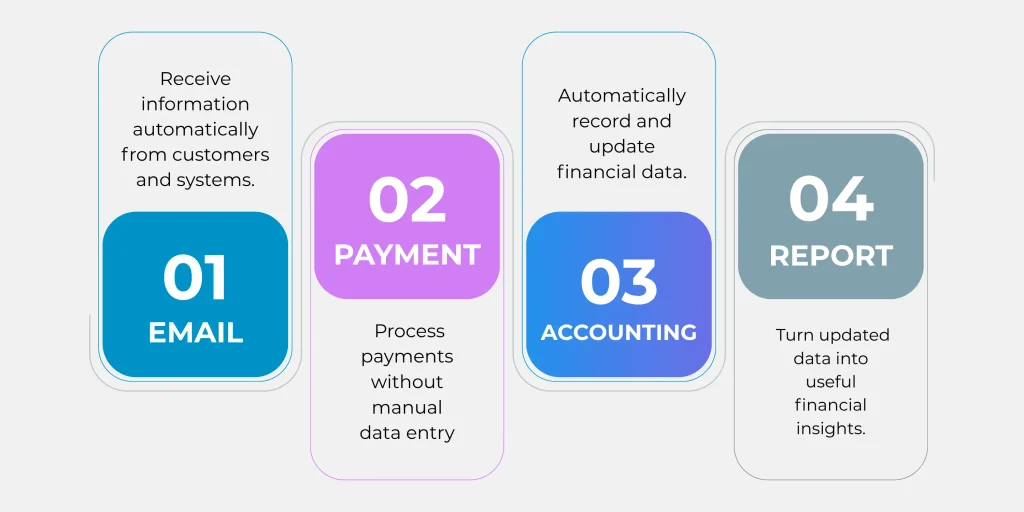
Earlier, AI tools mainly analyzed data and gave recommendations. For example, they could identify an unusual expense or detect a possible accounting error, but a person still had to review the information and decide what to do next.
Today, AI agents can do more than provide suggestions. They can automate routine tasks such as categorizing expenses, matching invoices with purchase orders, sending payment reminders, updating records, or drafting customer responses. In many businesses, these actions still happen within rules set by humans, and high-value or sensitive decisions usually require human approval.
This shift helps businesses save time, reduce manual work, and improve accuracy while keeping people in control of important financial and operational decisions.
2. Hyperautomation as a strategic priority
Most companies already use several automation tools, Mailchimp for emails, Stripe for payments, one for scheduling, and so on. The problem is these tools often don’t connect to each other, so people still have to move information between them by hand. Hyperautomation means linking all these separate tools into one connected system, so information flows automatically from one step to the next without a person copying or re entering it. Companies are now treating this as a top priority, not just a nice to have.
3. Predictive maintenance powered by AI and IoT
IoT means small sensors placed on machines or equipment. These sensors constantly collect information, like temperature, vibration, or speed, and send it to software. The software uses this information to spot early warning signs that a machine might break down soon. This lets a company repair or replace a part before it fails, instead of waiting for the machine to stop working and causing a costly delay. It’s like a doctor catching an illness early instead of only treating it after it becomes serious.
4. Collaborative robots (cobots) working alongside people
Cobots are robots designed to work safely in the same space as human workers, unlike older factory robots that had to be kept behind safety cages. Cobots usually handle tasks that are repetitive, tiring, or physically risky, like lifting heavy items or doing the same motion thousands of times a day.
Meanwhile, the human worker focuses on tasks that need judgment, problem solving, or flexibility. The goal isn’t to replace workers, but to let humans and robots each do what they’re best at.
5. Self-hosted and open-source automation tools gaining ground
Most automation software runs on a company’s servers, meaning the business doesn’t fully control where its data goes. “Self hosted” means a company runs the automation software on its own computers or private servers instead of someone else’s cloud. “Open source” means the software’s code is publicly available, so a company can inspect, customize, or improve it.
Businesses that handle sensitive information, like financial records or personal data, are increasingly choosing these options because it gives them more control and privacy over their data.
6. Continuous, real-time processes replacing periodic ones
In the past, many business processes ran on a schedule, like closing the books once a month, or updating inventory once a day. This meant the information people worked with was often outdated by the time they saw it. Now, automated systems update information continuously, as soon as something happens. For example, instead of finding out about a sales problem a month later, a manager can see it the moment it occurs. This gives people fresher, more accurate information to make decisions with.
7. Governance and security built into automation from the start
As automated systems are given more power to make decisions and access sensitive data, the risk of something going wrong, a mistake, a security breach, or an unfair decision, also increases. “Governance” means having clear rules for what automation is allowed to do, who is responsible for it, and how its actions are reviewed and tracked.
Instead of adding these safety checks later, companies are now building them in from the very beginning, so every automated action can be traced, reviewed, and corrected if needed.
What This Means for Your Business
If you’re still relying on manual invoice entry, spreadsheets, and disconnected software, you’re not alone. Many teams are in the same position. But the businesses gaining an edge in 2026 are the ones treating these accounting automation trends as a priority rather than an afterthought. Starting with one area, like accounts payable, is often the easiest way to begin.
Also Read: How AI and Automation Are Transforming New Businesses
Final Thoughts
Automation isn’t about removing people from accounting. It’s about removing the repetitive, error-prone parts of the job so your team can spend its energy on accuracy, insight, and strategy instead of chasing invoices and fixing typos. The finance teams that thrive in 2026 won’t be the ones with the biggest budgets. They’ll be the ones who used technology to buy back their time.
So take stock of where your team stands today. Are you still doing the work a machine could do faster and more accurately? Staying on top of accounting automation trends now, and acting on even one of them, will put you in a stronger position to make smarter decisions about where to invest next.
Frequently Ask Questions
Which is the latest automation tool?
AI-native platforms such as Puzzle, along with newer agentic AI tools, represent the latest wave of automation technology. Unlike older software, these tools can complete multi-step tasks like reconciliations or expense reports on their own, with only light human review.
Which automation tool is in demand in 2026?
For day-to-day bookkeeping, CapiPlan remain the most widely used and in-demand among small and mid-sized businesses.
0 Comments