
Accounting used to mean stacks of paper, endless spreadsheets, and hours spent checking numbers by hand. Today, that’s changing fast. Generative AI is moving into the accounting world, and the shift isn’t just hype; real firms are already using it and measuring real results. In this blog, we’ll look at how generative AI is reshaping accounting, what the numbers actually show, and what businesses should know before adopting it.
Table of Contents
What is Generative AI?
Before we go further, let’s answer a simple question: what is generative AI? In easy words, generative AI is a type of artificial intelligence that can create new content, text, reports, summaries, and even code based on the information it’s given. Unlike older accounting software that just follows fixed rules (like a formula in a spreadsheet), generative AI can understand context, learn patterns from data, and produce human-like output on its own.
In accounting, this means AI can now write financial summaries, spot unusual transactions, answer questions about company data, explain accounting standards in plain language, and draft reports tasks that used to take accountants many hours.
Why Accounting Needs Generative AI
Accounting is full of repetitive, detail-heavy work. Entering invoices, reconciling accounts, checking for errors, and preparing reports all take time and focus. Small mistakes can lead to big problems, especially during audits or tax season, when deadlines are tight and the margin for error is small.
This is where enterprise generative AI tools come in. Large companies are using enterprise generative AI tools such as Google Gemini Enterprise and Microsoft 365 Copilot to process huge volumes of financial data without slowing down. These tools don’t just save time; they reduce the kind of human error that creeps in when people work long hours on repetitive tasks. That said, the return isn’t automatic: separate CFO.com research found only about 28% of finance teams with AI investments are seeing measurable financial impact so far, which suggests how a tool is implemented matters as much as whether it’s adopted at all.
Key Ways Generative AI is Changing Accounting
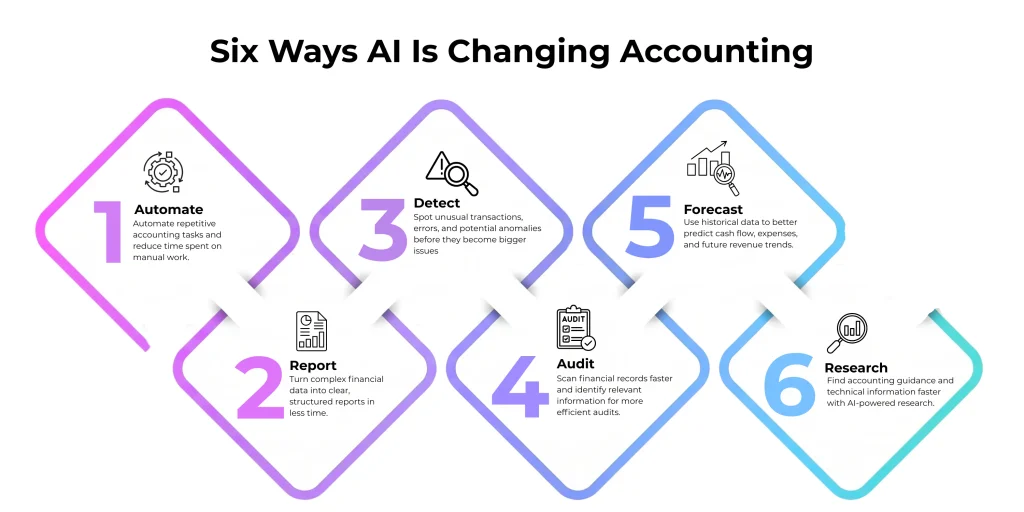
1. Automating Routine Tasks
A generative ai tool can sort transactions, match invoices to payments, and flag anything that looks unusual, often in seconds rather than hours. This frees up accountants to focus on analysis and judgment instead of data entry.
2. Smarter Financial Reporting
Generative AI can read raw financial data and turn it into clear, structured reports. Instead of spending days building a report manually, finance teams can get an accurate first draft in minutes, then review and finalize it cutting production time significantly while keeping a human in charge of the final sign-off.
3. Better Fraud and Anomaly Detection
AI models are good at spotting patterns across large volumes of transactions. When something breaks the usual pattern; a duplicate invoice, an unusual vendor payment, a mismatched amount, generative AI can flag it immediately, often catching issues that a manual review would miss until much later.
4. Faster, More Thorough Audits
Audits usually involve digging through months of records. Generative AI can scan large datasets quickly, pull out relevant transactions, and explain its findings in plain language, which shortens the audit cycle and gives auditors more time to focus on judgment calls rather than data gathering.
5. Improved Forecasting
By analyzing historical financial data, generative AI can help predict future cash flow, expenses, and revenue trends with more precision than simple spreadsheet models, giving leadership a clearer picture of what’s coming so they can plan ahead.
6. Faster Research and Technical Guidance
Rather than manually searching through accounting standards, internal policies, or prior workpapers, finance professionals are increasingly using generative AI to retrieve relevant guidance, summarize technical rules, and explain accounting treatments cutting down research time that used to eat into billable or productive hours.
Generative AI Beyond Accounting: HR and Procurement
Generative AI isn’t only useful for finance teams — it’s spreading across other departments too.
Generative AI in HR is being used to write job descriptions, screen resumes, and answer employee questions about policies, saving HR teams significant time on repetitive communication and paperwork.
Similarly, generative AI in procurement is changing how companies manage purchasing. From analyzing supplier contracts to comparing vendor prices and flagging risk in a supply chain, AI tools help procurement teams make faster, better-informed decisions. Many businesses are now adopting a generative ai procurement software solution to automate purchase orders, track spending, and identify cost-saving opportunities that would be hard to spot manually across thousands of transactions.
This shows generative AI isn’t a one-department tool – it’s becoming part of how entire businesses operate, with finance, HR, and procurement all pulling from the same underlying technology.
Benefits for Businesses
- Time savings – Routine tasks that took hours can be completed in minutes.
- Fewer errors – AI reduces the risk of manual mistakes in calculations and data entry.
- Cost efficiency – Less time on manual work means lower operational costs over time.
- Better decision-making – Faster access to accurate data helps leaders act sooner.
- Scalability – As a business grows, AI tools can handle more data without needing a proportionally bigger team.
Choosing the Right Generative AI Tool
With so many options available, picking the right generative ai tool can feel overwhelming. Businesses should look for tools that:
- Integrate easily with existing accounting software and ERPs
- Offer strong data security and clear compliance credentials
- Are simple enough for teams to learn without a long onboarding curve
- Provide clear, explainable outputs rather than unexplained “black box” answers
- Come from a vendor with a track record and responsive support
Taking time to evaluate these factors helps businesses avoid costly missteps and get real value from their investment, rather than ending up with an underused tool sitting on top of the existing workflow.
Suggested: The Biggest Accounting Automation Trends in 2026
The Future of Accounting with Generative AI
As generative AI keeps improving, its role in accounting will likely deepen further. Industry surveys already show finance leaders expect the biggest impact in controllership and financial reporting over the next few years, with tools moving beyond simple automation into supporting documentation review, technical research, and recurring reporting all while human teams keep final approval authority.
Accountants won’t be replaced, but their day-to-day work is shifting: less time spent manually entering and checking numbers, more time spent reviewing AI-generated insights, applying judgment, and advising on strategy. Businesses that adopt enterprise generative ai thoughtfully with proper training, governance, and data controls are the ones most likely to see the returns the data promises.
Wrap Up!
Generative AI is no longer just a buzzword; it’s a measurable part of how modern accounting works, backed by real adoption numbers and real efficiency gains like shorter close cycles and reduced manual work. As more businesses explore enterprise generative ai tools, those who adopt the technology thoughtfully, with proper training and oversight, are the ones most likely to end up ahead; saving time, cutting costs, and making sharper financial decisions.
Frequently Ask Question
Is generative AI safe to use for financial data?
It can be, but only with the right safeguards — strong data security, clear usage policies, and human oversight on important financial decisions. Without these, there's a real risk of confidential data being entered into public AI tools by mistake.
Can generative AI replace accountants?
No. It automates repetitive tasks like data entry and first-draft reporting, but accountants are still essential for judgment

0 Comments