
Running a business means making decisions every day. But when the numbers don’t make sense, even simple decisions become stressful. Understanding essential accounting terms helps business owners track money, avoid mistakes, and stay in control. Once these terms are clear, managing finances becomes far less confusing.
This guide explains the most important and basic accounting terms in simple language. These basic accounting terms will help you understand your finances clearly and run your business with confidence.
Let’s explore the most important key accounting terms to know.
Table of Contents
1. Assets
Assets are everything a business owns that has financial value and can help generate income in the future. They support daily operations and show the overall strength of a company.
Types of assets:
- Current assets – cash, bank balance, inventory, accounts receivable
- Fixed assets – machinery, furniture, vehicles, buildings
- Intangible assets – trademarks, software, goodwill
Assets appear on the balance sheet and help lenders and investors judge financial health. Businesses with strong assets can secure loans more easily and handle financial emergencies better. Managing assets properly ensures long-term stability and growth.
2. Liabilities
Liabilities are the debts and obligations a business must pay in the future. They arise when a company borrows money, buys goods on credit, or owes taxes.
Types of liabilities:
- Current liabilities – due within one year (supplier payments, utility bills)
- Long-term liabilities – due after one year (bank loans, equipment financing)
Tracking liabilities helps businesses avoid excessive debt and maintain a healthy financial structure. If liabilities grow faster than income, the business may face financial stress.
3. Revenue

Revenue is the total income a business earns from selling its products or services before any expenses are deducted. It represents the money coming into the business and is often referred to as sales or income.
Examples of revenue include service fees, product sales, and subscription income. Revenue indicates how well a business is performing in terms of customer demand and market reach. However, high revenue alone does not guarantee profit. To achieve real financial growth, businesses must control expenses and manage costs alongside revenue generation. Understanding revenue is one of the key accounting terms every business owner should know.
4. Expenses
Expenses are the costs a business incurs to operate and run its daily activities. They include all payments required to keep the business functioning smoothly and are recorded on the income statement to calculate profit or loss.
Common expenses include rent and utilities, employee salaries, marketing and advertising costs, office supplies, and other operational payments. Tracking and managing expenses is essential because it helps business owners identify unnecessary spending, plan budgets effectively, and make informed financial decisions. Regular review of expenses ensures better cost control, protects profit margins, and contributes to the overall financial health and growth of the business.
5. Profit and Loss (P&L)
Profit and Loss (P&L) shows whether a business is making money or incurring losses over a specific period. Profit is the amount left after subtracting all expenses from revenue, while a loss occurs when expenses exceed revenue. Businesses rely on the P&L statement to evaluate performance, make decisions, and plan for growth.
There are two important types of profit:
- Gross profit, which is revenue minus the cost of goods sold.
- Net profit, which is the final earnings after all operating and non-operating expenses are deducted.
Regularly monitoring profit trends helps business owners identify areas to reduce costs, adjust pricing strategies, and improve overall efficiency. Understanding P&L is one of the most essential accounting terms to know for measuring business success and financial health.
6. Accounts Receivable
Accounts receivable is the money customers owe a business after buying goods or services on credit. It is considered a short-term asset because the business expects to receive it soon. Managing accounts receivable is very important because late payments can create cash problems and make it hard for the business to pay salaries, suppliers, or other bills.
Accounts receivable is important because it affects cash flow, shows how customers pay, and helps plan for incoming money. To handle it well, businesses should set clear payment terms, send invoices on time, and follow up on late payments. Proper accounts receivable management keeps cash flow steady, reduces the risk of unpaid bills, and helps the business stay financially healthy.
7. Accounts Payable
Accounts payable is the money a business owes to suppliers or vendors for goods or services it has received but hasn’t paid for yet. It is recorded as a liability on the balance sheet and is important for managing short-term financial obligations. Keeping track of accounts payable helps businesses know what they owe and plan their cash flow properly.
Managing accounts payable carefully helps businesses pay suppliers on time, avoid late fees, and use cash efficiently. Paying too early can tie up money that could be used elsewhere, while paying too late can hurt relationships with suppliers. A good accounts payable system keeps cash flow healthy, maintains trust with vendors, and supports the overall financial stability of the business.
8. General Ledger
The general ledger is the main record of all a business’s financial transactions. It keeps track of money coming in and going out, organized into different accounts like assets, liabilities, income, expenses, and equity. By keeping everything in one place, the general ledger gives a clear picture of the company’s financial situation.
All important financial reports, like the balance sheet and profit and loss statement, are created using information from the general ledger. Checking the ledger regularly helps find mistakes, prevent errors, and keep financial records accurate. Understanding the general ledger is one of the key accounting terms because it ensures the business’s finances are clear and reliable.
9. Journal Voucher (JV)
A Journal Voucher (JV) is a document used to record accounting transactions that do not involve cash receipts or payments. It is used to correct errors, make adjustments (like depreciation or accrued expenses). JVs help ensure that financial records are accurate and that financial statements reflect the true financial position of a business.
Understanding what is JV in accounting terms is important for keeping accurate records and following audit rules. Businesses usually use JVs at the end of the month or year to make adjustments, finalize accounts, and prepare reports. Using JVs properly helps prevent mistakes, keeps records clear, and ensures financial statements are correct and reliable.
10. Freight
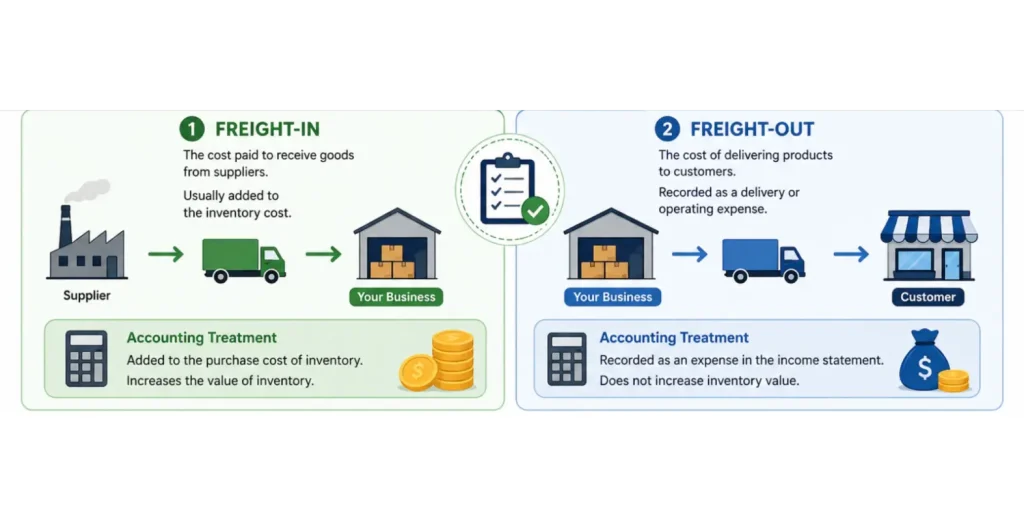
Freight refers to the cost of transporting goods from one place to another during the buying or selling process. In simple terms, it is the shipping expense a business pays to move products. When understanding what is freight in accounting terms, it is important to know that these costs affect the total cost of goods and overall profitability. Freight charges may include shipping fees, handling costs, and transportation insurance.
There are two common types of freight:
- Freight-in is the cost paid to receive goods from suppliers and is usually added to the inventory cost.
- Freight-out is the cost of delivering products to customers and is recorded as a delivery or operating expense.
Recording freight correctly ensures accurate product costing and helps businesses set profitable prices. Knowing what is freight in accounting terms helps companies control inventory cost and maintain accurate financial records.
11. Reconciliation
Reconciliation meaning in accounting terms refers to the process of comparing two sets of financial records to ensure they match and are accurate. Businesses perform reconciliation to confirm that transactions recorded in their books agree with external records such as bank statements, supplier statements, or cash balances.
Common examples include matching the bank statement with the company’s cash book or checking ledger balances against actual cash. Regular reconciliation helps find missing entries, timing differences, bank fees, or mistakes. Understanding reconciliation meaning in accounting terms is important because it prevents fraud, keeps financial records accurate, and builds trust in the business’s finances.
12. Cash Flow
Cash flow refers to the movement of money in and out of a business over a specific period. It shows whether a company has enough cash available to run daily operations and meet its financial obligations. A business can appear profitable on paper but still face serious problems if it does not have enough cash to pay salaries, rent, suppliers, or utility bills on time.
Cash flow is usually divided into three types:
- Operating cash flow comes from daily business activities such as sales income and payments for expenses.
- Investing cash flow includes money spent on or received from long-term assets, such as purchasing equipment or selling property.
- Financing cash flow relates to funds received from loans or investors and payments made toward loan repayments or dividends.
Maintaining positive cash flow ensures financial stability, prevents disruptions, and allows business owners to plan for growth and unexpected expenses, as profit vs cash flow can differ and strong profits do not always mean enough cash is available.
13. Cost of Goods Sold (COGS)
Cost of Goods Sold (COGS) is the total cost of making or buying the products a business sells during a certain period. It includes costs like raw materials, labor used to make products, and other production expenses. COGS does not include things like rent, marketing, or office salaries.
Understanding COGS is important because it helps calculate gross profit and set the right product prices. It also shows how efficiently a business produces goods. If production costs go up but prices stay the same, profit goes down. Businesses can improve profits by reducing waste, negotiating better deals with suppliers, and making production more efficient. Tracking COGS accurately ensures financial statements show the true cost of products.
14. Equity
Equity represents the owner’s share or financial interest in a business after all liabilities have been deducted from assets. In simple terms, it shows what the business truly owns once all debts are paid. Equity includes the owner’s initial investment, retained earnings (profits reinvested into the business), and any additional capital contributions. It decreases when the owner withdraws money or when the business suffers losses.
Strong equity indicates financial stability and long-term sustainability, making it easier to secure loans or attract investors. As a business earns profits and reinvests them instead of withdrawing funds, equity grows over time, increasing the overall value of the company.
Also Read: 5 Accounting Mistakes Hurting Your Business
Final Thoughts
Understanding essential accounting terms is not just for accountants. Business owners who learn these basic accounting terms gain better control over their finances and make smarter decisions.
From knowing what is JV in accounting terms to understanding what is freight accounting in terms and the reconciliation meaning in accounting terms, these concepts build a strong financial foundation.
Mastering these key accounting terms helps business owners monitor performance, avoid financial errors, improve cash flow and make confident decisions.
The more familiar you become with these key accounting terms to know, the easier it becomes to manage and grow your business successfully.
Frequently Ask Questions
What are the 7 types of bank account?
The seven types of bank accounts are savings account, current account, fixed deposit account, recurring deposit account, salary account, NRI account, and joint account. A savings account is used to save money and earn interest, while a current account is used by businesses for frequent transactions. Fixed and recurring deposit accounts are used for saving money over a fixed period with higher interest. Salary accounts are opened for employees to receive salaries, NRI accounts are for non-resident Indians, and joint accounts are shared by two or more people.
What are the five basic terms of accounting?
The five basic terms of accounting are assets, liabilities, equity, revenues, and expenses. These are the main categories used to record and organize all financial transactions.

0 Comments