
A business can have strong sales and still struggle to pay its bills on time. The reason? Its money may be tied up in inventory, unpaid invoices, or other short-term assets. This is where the working capital ratio becomes useful. It gives businesses a quick view of whether they have enough current assets to cover their short-term obligations and manage day-to-day financial needs.
Table of Contents
What Is the Working Capital Ratio?
A business can be profitable and still struggle to pay its short-term bills. This is where working capital becomes important. The working capital ratio is a financial measure that shows whether a business has enough short-term assets to cover its short-term liabilities.
In simple terms, it helps answer one important question: Can the business pay what it owes in the near future?
The ratio compares current assets, such as cash, accounts receivable, and inventory, with current liabilities, such as unpaid bills, short-term loans, and other obligations due within a year.
A strong ratio can indicate that a business has enough resources to manage its short-term financial commitments. A very low ratio, however, may point to cash flow pressure.
Why Is the Working Capital Ratio Important?
Managing daily finances is an important part of running a healthy business. Even when sales are growing, a company may face problems if it does not have enough cash or other current assets to cover upcoming payments.
The working capital ratio gives business owners and finance teams a quick view of short-term financial strength. It can help them:
- Monitor short-term financial health
- Identify potential cash flow problems
- Plan upcoming payments
- Understand how efficiently current assets are being managed
- Make better financial decisions
- Compare financial performance over time
Businesses can also use the ratio when reviewing their financial statements or preparing for future growth.
Working Capital Ratio Formula
The working capital ratio formula is simple:
Working Capital Ratio = Current Assets ÷ Current Liabilities
For example, suppose a business has:
- Current assets: $100,000
- Current liabilities: $50,000
The calculation would be:
$100,000 ÷ $50,000 = 2
This means the business has $2 in current assets for every $1 of current liabilities.
Suggested: 5 Cash Flow Metrics You Should Be Tracking in 2026
How to Calculate the Working Capital Ratio
If you are wondering how to calculate the working capital ratio, start by identifying the business’s current assets and current liabilities.
Step 1: Add Current Assets
Current assets are resources that can normally be converted into cash within one year. They may include:
- Cash and bank balances
- Accounts receivable
- Inventory
- Short-term investments
- Other short-term assets
Step 2: Add Current Liabilities
Current liabilities are financial obligations that are generally due within one year. These can include:
- Accounts payable
- Short-term loans
- Accrued expenses
- Taxes payable
- Other short-term obligations
Step 3: Apply the Formula
Divide total current assets by total current liabilities. The result is the business’s working capital ratio.
What Is a Healthy Working Capital Ratio?
So, what is a healthy working capital ratio?
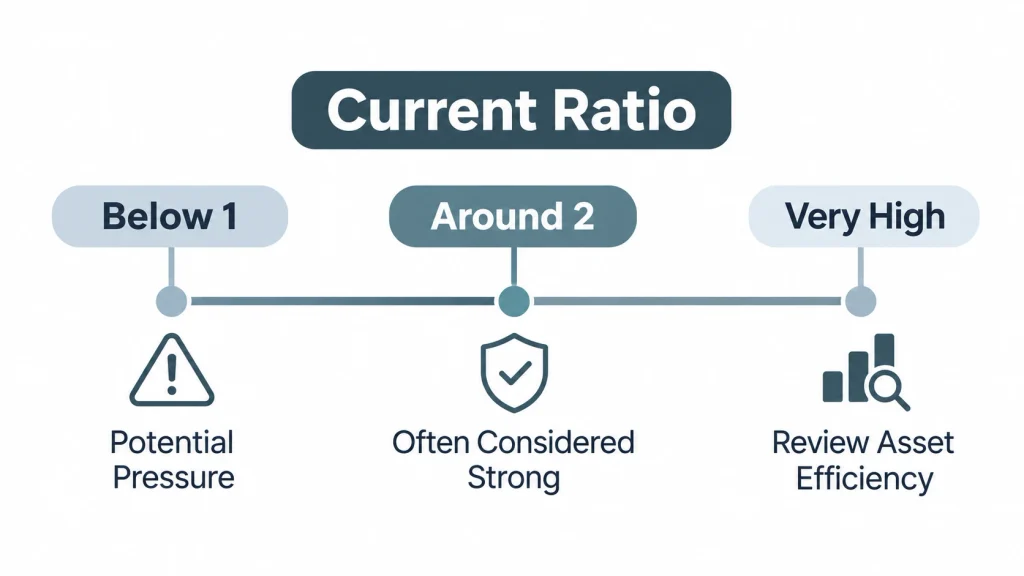
A ratio of around 2.0 is often viewed as a strong position because the business has twice as many current assets as current liabilities. However, there is no single ideal ratio for every business.
The right level depends on the industry, business model, payment cycles, inventory needs, and how quickly the company collects customer payments.
A ratio below 1 may indicate that current liabilities are higher than current assets. This can create pressure when bills and other short-term payments become due.
On the other hand, an extremely high ratio is not always positive. It may mean that too much money is tied up in inventory, receivables, or other current assets instead of being used productively.
Therefore, businesses should look at the ratio together with other financial metrics rather than relying on one number.
Working Capital Ratio vs Net Working Capital Ratio
The terms working capital ratio and net working capital ratio are sometimes used interchangeably, but they can refer to different calculations.
Working capital ratio focuses on the relationship between current assets and current liabilities.
Net Working Capital = Current Assets − Current Liabilities
For example, if current assets are $100,000 and current liabilities are $50,000, net working capital is $50,000.
Both measures provide useful information, but they answer slightly different questions. The ratio shows the relationship between assets and liabilities, while net working capital shows the actual amount left after short-term liabilities are deducted.
What Can a Low Ratio Tell You?
A low working capital ratio may signal that a business could have difficulty meeting short-term obligations. This does not automatically mean the business is financially unhealthy, but it deserves attention.
For example, a company may have strong sales but slow customer payments. Its accounts receivable could be high while its available cash remains low.
Businesses can respond by improving collections, managing inventory more carefully, reviewing expenses, and monitoring upcoming payments.
What Can a High Ratio Tell You?
A high ratio generally means the business has more current assets compared with its current liabilities. This can provide greater flexibility for managing short-term obligations.
However, an unusually high ratio may also suggest inefficient use of resources. For example, excess inventory or unpaid customer invoices can increase current assets without improving actual cash availability.
This is why businesses should review what makes up their current assets instead of looking at the ratio alone.
How Accounting Software Can Help
Tracking working capital manually can become difficult as a business grows. Accounting software can bring invoices, payments, expenses, receivables, inventory, and financial reports into one place.
With up-to-date financial information, businesses can monitor their current assets and liabilities more easily and identify changes in working capital. This can support better cash flow planning and faster financial decisions.
Let’s Wrap Up!
The working capital ratio is a simple but useful way to understand a business’s short-term financial position. By comparing current assets with current liabilities, it shows whether a company has enough short-term resources to cover its upcoming obligations.
However, a healthy ratio is not the same for every business. Industry conditions, cash flow, inventory, customer payments, and other financial factors should also be considered.
Regularly monitoring the ratio can help businesses spot potential problems early and make more informed financial decisions.

0 Comments