
In 2026, businesses are working in a fast digital world where speed, accuracy, and real-time data matter more than ever. This has made one debate very common in finance teams: manual vs automated accounting.
Some businesses still trust traditional methods. Others have fully moved to digital tools. But the real question is simple. What actually works better today? The answer is not just about technology. It is about efficiency, control, cost, and how modern businesses handle their daily financial operations.
In this blog, we will break down manual vs automated system differences in a clear and practical way so you can understand what fits your business needs.
Table of Contents
Manual vs Automated Accounting: A Quick Overview
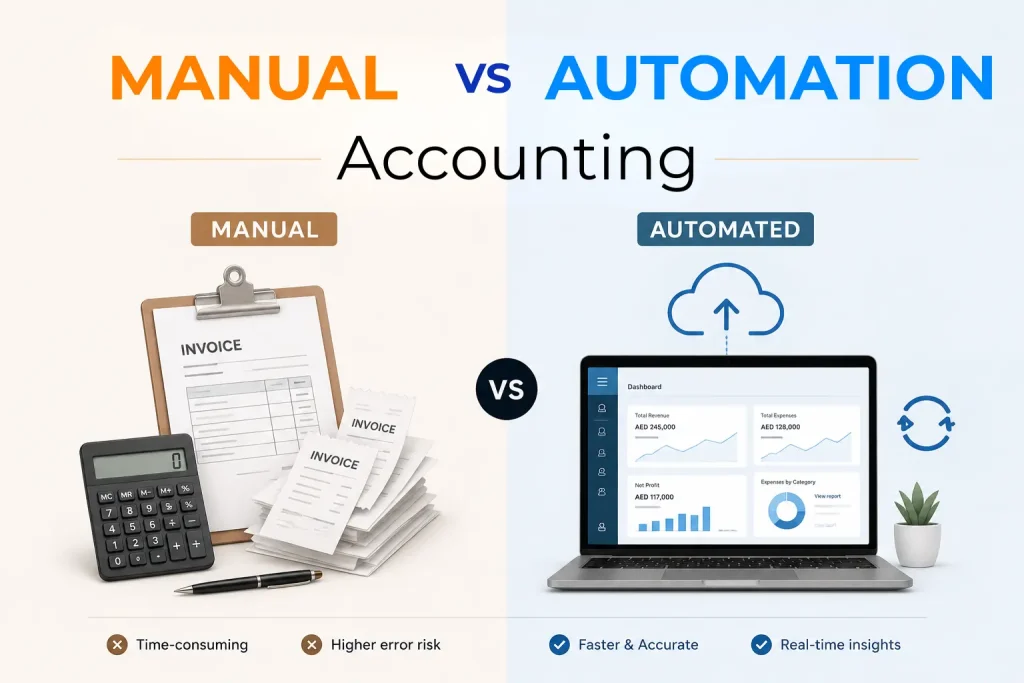
Before comparing both systems, it is important to understand what they actually mean.
Manual accounting involves recording financial transactions by hand or using basic spreadsheets. Everything entries, calculations, and reports is done manually.
Automated accounting uses software to handle financial tasks like recording, processing, and reporting. It reduces human effort and improves speed and accuracy.
In simple terms, the manual vs automated process is about human effort versus system-driven efficiency.
Manual vs Automated Accounting: Detailed Comparison
| Feature | Manual Accounting | Automated Accounting |
| Data Entry | Manual input by staff | Automatic system entry |
| Speed | Slow and time-consuming | Fast and real-time |
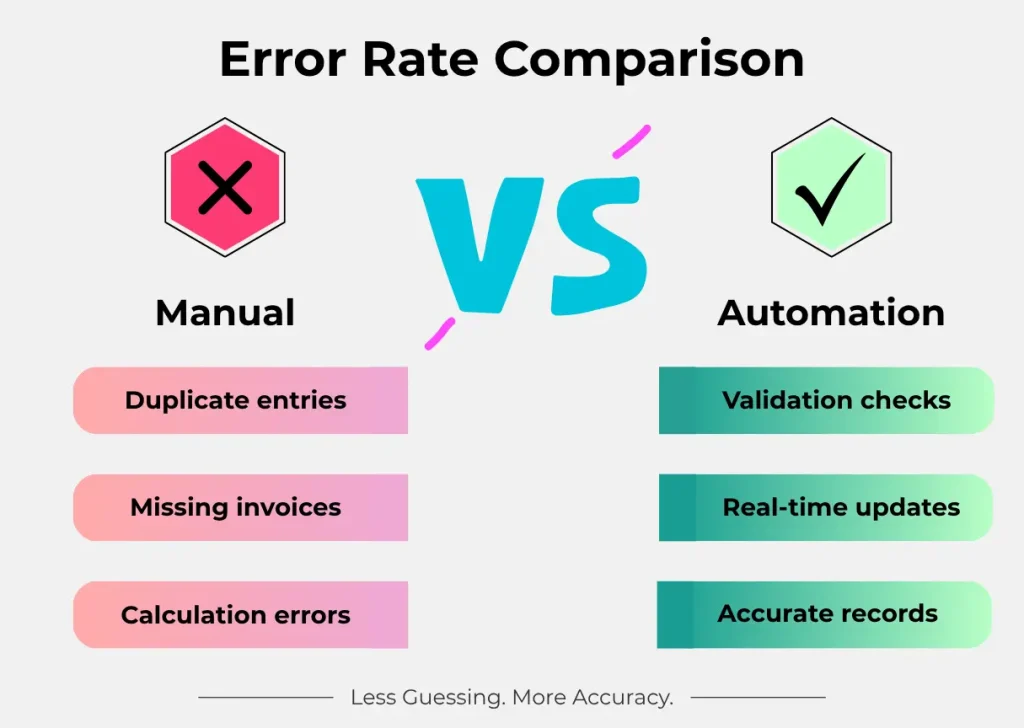
| Errors | Higher risk of mistakes | Low error rate with validation |
| Cost | Low setup, high labor cost | Higher setup, lower long-term cost |
| Reporting | Manual report creation | Instant reports and dashboards |
| Scalability | Hard to manage growth | Easily scalable |
| Inventory Tracking | Physical and error-prone | Real-time automated updates |
| Internal Controls | Dependent on human checks | Strong system-based controls |
| Decision Making | Based on delayed data | Based on real-time insights |
This comparison clearly shows how manual vs automated system performance differs in daily business operations.
Where Manual Accounting Still Fits
Even in 2026, manual systems are not completely irrelevant. They still work well in:
- Very small businesses
- Low transaction volumes
- Simple bookkeeping needs
- Early-stage startups with limited budgets
In such cases, the manual vs automated business process comparison shows that manual systems can still be manageable and cost-effective at a basic level. However, as business activity increases, manual systems often become harder to maintain.
Why Automation Is Taking Over Finance
Most growing businesses are shifting toward automation because it solves key problems that manual systems cannot handle efficiently. Automated accounting provides:
- Faster processing and reporting
- Real-time financial updates
- Reduced human errors
- Better compliance tracking
- Smarter financial insights
In the manual vs automated system comparison, automation clearly improves productivity and decision-making speed. Instead of spending hours on calculations, teams can focus on strategy and financial planning.
Manual vs Automated Data Entry and Collection
One of the biggest differences between these systems is the way data is handled. In manual accounting, employees must enter every transaction individually, which takes more time and increases the chances of duplication and human errors. Automated systems simplify this process by capturing and updating data automatically, making financial management faster and more accurate.
In automated systems, data is captured directly from invoices, bank feeds, or integrated platforms.
Automation has also changed the way businesses collect and manage data. In manual systems, teams often gather information from different sources separately, which takes more time and increases the chances of missing or outdated data. Automated systems collect, organize, and update information in real time, helping businesses improve accuracy and work more efficiently.
Inventory and Control Systems: A Big Upgrade
Inventory management is another area where automation has made a strong impact. A manual vs automated inventory system comparison shows: Manual systems:
- Require physical tracking
- Are prone to stock errors
- Need frequent manual updates
Automated systems:
- Track inventory in real time
- Send low-stock alerts
- Reduce overstocking and waste
At the same time, automated controls have significantly improved internal monitoring. Automated systems can detect unusual activity, maintain audit logs, and reduce fraud risks more effectively than manual checks.
Cost Perspective: Short-Term vs Long-Term Thinking
At first glance, manual systems may look cheaper because they don’t require software investment. However, hidden costs include:
- High labor requirements
- Time spent on corrections
- Inefficiency in reporting
Automated systems require investment but offer long-term savings by reducing manual workload and improving accuracy. So in the manual vs automated business process, automation often proves more cost-efficient over time.
Which System Is Better in 2026?
There is no one-size-fits-all answer. The right choice depends on business size and complexity. Manual accounting may still work if:
- The business is very small
- Transactions are minimal
- Budget is limited
Automated accounting is better if:
- The business is growing
- Daily transactions are high
- Real-time reporting is needed
- Accuracy and speed are priorities
In most modern cases, businesses are moving toward automation or using a hybrid model that combines both approaches.
Suggested: The Future of Finance: AI and Automation Insights
Conclusion: The Future Clearly Favors Automation
The debate of manual vs automated accounting is no longer about tradition versus technology. It is about efficiency, accuracy, and business growth. Manual systems still have value for simple and small-scale operations. But as businesses grow, the limitations become more visible; slow processing, higher errors, and limited scalability.
On the other hand, automation offers speed, control, and real-time insights that modern businesses need to compete in 2026.
In the end, the manual vs automated system comparison shows a clear trend: automation is becoming the standard for smart financial management, while manual systems are slowly taking a supporting role. The smartest approach today is choosing the system that not only works now but also supports future growth.
Frequently Ask Questions
Is it better to go automatic or manual?
It depends on the size and needs of the business. Manual systems can work for small operations with fewer transactions. But for most modern businesses, automated systems are better because they save time, reduce errors, and improve efficiency.
What is the difference between manual and automated?
The main difference between manual and automated systems is how work is done. Manual systems depend on human effort for recording, calculations, and updates, which makes them slower and more prone to errors. Automated systems use software to handle these tasks quickly and with higher accuracy, saving time and improving efficiency.

0 Comments