
Numbers don’t lie, but they don’t explain themselves either. A company can post huge revenue and still be in trouble, or look small on paper while being financially rock-solid. The difference is visible only when you know the key financial ratios to check.
This blog breaks down the six most important financial ratios, their financial ratios formulas, and why it matters.
Table of Contents
What Are Financial Ratios?
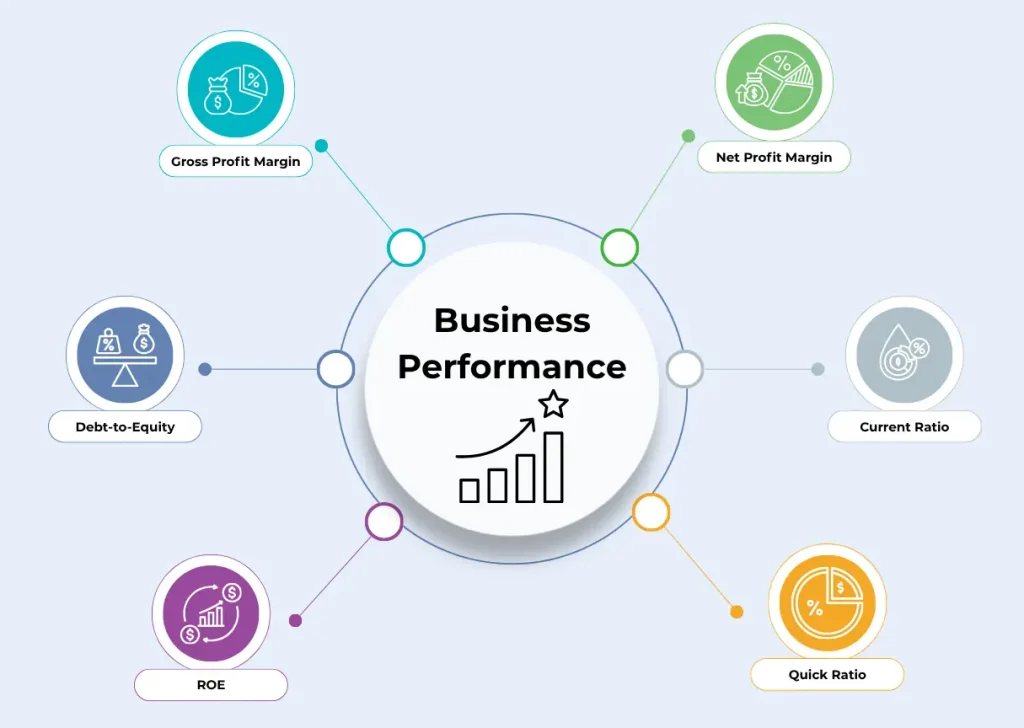
Financial ratios are calculations that compare two or more numbers from a company’s financial statements usually the balance sheet, income statement, or cash flow statement. Instead of staring at long spreadsheets, ratios give you a quick, comparable snapshot of profitability, efficiency, liquidity, and financial health.
There’s a long list of all financial ratios used in accounting and finance, but you don’t need to memorize them all. A handful of well-chosen ratios can tell you almost everything you need to know about a business’s performance.
1. Gross Profit Margin
Gross profit margin shows how efficiently a company produces its goods or services before accounting for overhead costs like rent, salaries, or marketing.
Formula: ((Revenue – COGS) / Revenue) × 100, or (Gross Profit / Revenue) × 100
A higher margin means the company keeps more money from each sale after covering direct production costs. This is one of the core financial ratios profitability metrics, and it’s often the first number analysts check when comparing companies in the same industry.
2. Net Profit Margin
While gross margin looks at production efficiency, net profit margin looks at the bigger picture, how much profit remains after every single expense, including taxes and interest, has been paid.
Formula: Net Profit Margin = Net Income ÷ Revenue × 100
This ratio answers a simple question: out of every dollar earned, how much actually turns into profit? It’s a favorite among investors because it reflects the overall financial discipline of a company, not just its sales performance.
3. Current Ratio
The current ratio is a liquidity ratio, meaning it measures whether a business can pay its short-term bills using its short-term assets.
Formula: Current Ratio = Current Assets ÷ Current Liabilities
A ratio above 1 generally suggests the company can cover its obligations for the next 12 months. A ratio below 1 could be a warning sign of cash flow trouble, even if the business looks profitable on paper. This makes it one of the most practical key financial ratios for day-to-day financial health checks.
4. Quick Ratio (Acid-Test Ratio)
The quick ratio is a stricter version of the current ratio. It excludes inventory, since inventory isn’t always easy to convert into cash quickly.
Formula: Quick Ratio = (Current Assets − Inventory) ÷ Current Liabilities
This ratio is especially useful for businesses where inventory takes time to sell, such as manufacturing or retail. It gives a more honest picture of how well a company can handle an unexpected cash crunch.
5. Return on Equity (ROE)
Return on Equity shows how effectively a company uses shareholders’ money to generate profit. It’s a favorite ratio among investors trying to judge management performance.
Formula: Return on Equity = (Net Income ÷ Shareholders’ Equity) × 100
A strong ROE suggests that a company is turning invested capital into real profit efficiently. Comparing ROE across companies in the same sector is a common part of any solid financial ratios analysis, since it highlights which businesses are truly rewarding their owners or investors.
6. Debt-to-Equity Ratio
This ratio measures how much a company relies on borrowed money compared to its own capital. It’s a key indicator of financial risk.
Formula: Debt-to-Equity Ratio = Total Liabilities ÷ Shareholders’ Equity
A high ratio means the business depends heavily on debt, which can be risky if revenue drops. A lower ratio usually signals a more conservative, stable financial structure. Lenders and investors pay close attention to this number before extending credit or making an investment.
Also Read: 10 Signs Your Financial Reporting Needs an Upgrade
Why These Ratios Matter Together
No single ratio tells the whole story. A business could have a great profit margin but poor liquidity, or strong revenue but heavy debt. That’s why professionals rely on a combination of ratios; profitability, liquidity, and leverage to get a balanced view.
If you’re building your own list of all financial ratios to track, start with these six. They cover the essentials: how much a company earns, how well it pays its bills, and how it’s financed. Once you’re comfortable with these, you can expand into more specialized ratios like inventory turnover, interest coverage, or asset turnover, depending on your industry.
Final Thoughts
Understanding financial ratios isn’t just for accountants; it’s a practical skill for anyone who wants to make smarter business or investment decisions. By regularly reviewing gross and net profit margins, liquidity ratios, ROE, and debt-to-equity, you get a clear, honest picture of business performance without getting lost in complicated financial statements.
Start applying these financial ratios formulas to your own business or to companies you’re researching, and you’ll quickly notice patterns that raw numbers alone never reveal.
Frequently Ask Questions
What's the difference between profitability ratios and liquidity ratios?
Profitability ratios, like gross and net profit margin, show how much money a business actually earns from its operations. Liquidity ratios, like the current and quick ratio, show whether a business can pay its short-term bills on time. Both are essential, but they answer very different questions about financial health.
Which financial ratio is most important for a small business?
Liquidity ratios like the current ratio often matter most for small businesses, since cash flow issues can shut down operations quickly. Profitability ratios matter too, but a business can survive low profit longer than it can survive no cash. Ideally, track a mix of both rather than relying on just one.

0 Comments