
If you own a business, understanding your profits is one of the most important parts of managing your finances. Many business owners hear the terms gross profit vs net profit but are unsure what they actually mean.
Both are important financial metrics, but they measure different things. Gross profit tells you how much money your business makes after covering the direct cost of producing goods or services. Net profit shows how much money is left after paying all business expenses.
Knowing the gross profit vs net profit difference helps you make better business decisions, control costs, and improve profitability.
In this guide, you’ll learn the gross profit vs net profit meaning, how to calculate each one, and why both matter for business success.
Table of Contents
What Is Gross Profit?
Gross profit is the money your business keeps after subtracting the direct costs of making or delivering your products or services.
These direct costs are known as the Cost of Goods Sold (COGS) and may include:
- Raw materials
- Manufacturing costs
- Direct labor
- Packaging
- Shipping (if directly related to production)
Gross profit does not include expenses like rent, salaries, marketing, office bills, taxes, or loan interest.
Gross Profit Formula
The gross profit vs net profit formula starts with calculating gross profit.
Gross Profit = Revenue – Cost of Goods Sold (COGS)
Example
Suppose your business earns $100,000 in sales.
Cost of Goods Sold = $60,000
Gross Profit:
$100,000 – $60,000 = $40,000
This means your business earned $40,000 before paying operating expenses.
What Is Net Profit?
Net profit is the money left after subtracting all business expenses from your total revenue.
It includes expenses such as:
- Rent
- Employee salaries
- Utilities
- Marketing
- Insurance
- Taxes
- Loan interest
- Office expenses
- Software subscriptions
Net profit is often called the “bottom line” because it appears at the bottom of an income statement.
Net Profit Formula
Net Profit = Revenue – Total Expenses
or
Net Profit = Gross Profit – Operating Expenses – Taxes – Interest – Other Expenses
Example
Continuing the previous example:
Revenue = $100,000
Gross Profit = $40,000
Other business expenses:
- Rent = $8,000
- Salaries = $12,000
- Marketing = $5,000
- Utilities = $2,000
- Taxes = $3,000
Total additional expenses = $30,000
Net Profit:
$40,000 – $30,000 = $10,000
Although the business earned $40,000 in gross profit, only $10,000 remained after paying all expenses.
Gross Profit vs Net Profit Difference
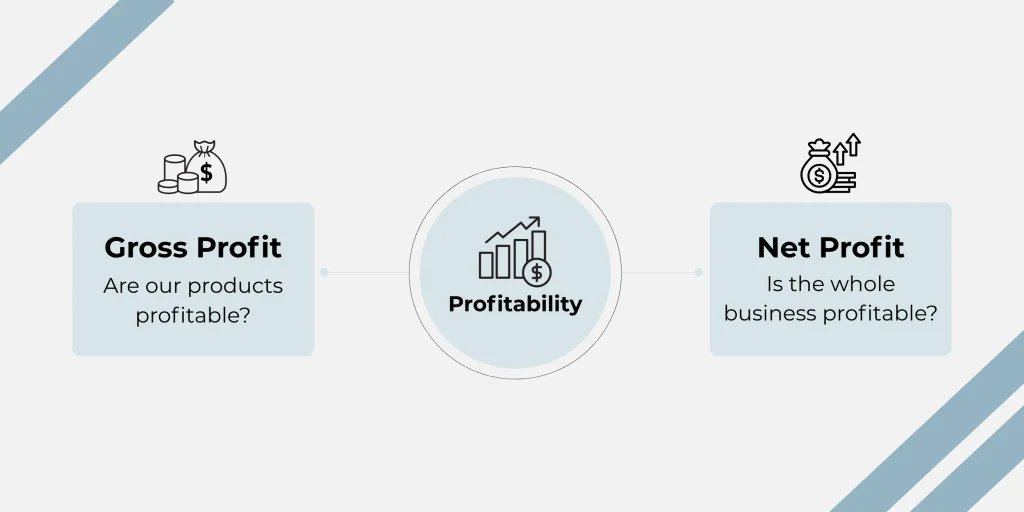
Understanding the gross profit vs net profit difference is simple.
| Gross Profit | Net Profit |
| Revenue minus Cost of Goods Sold | Revenue minus all expenses |
| Shows production profitability | Shows overall business profitability |
| Does not include operating expenses | Includes every business expense |
| Calculated before taxes and interest | Calculated after taxes and interest |
| Appears higher than net profit | Usually lower than gross profit |
Both numbers are important because they measure different aspects of your business performance.
Gross Profit vs Net Profit Meaning
The gross profit vs net profit meaning becomes easier when you think about where the money goes.
Imagine you own a clothing store.
You sell clothes worth $50,000.
It costs $30,000 to purchase the inventory.
Your gross profit is:
$50,000 − $30,000 = $20,000
But your business also pays:
- Shop rent
- Staff salaries
- Electricity
- Marketing
- Taxes
After paying all these expenses, you may only keep $6,000.
That final amount is your net profit.
So:
- Gross profit measures product profitability.
- Net profit measures business profitability.
What Is Gross Profit vs Net Profit Margin?
Besides profit amounts, businesses also calculate profit margins.
The gross profit vs net profit margin helps measure how efficiently a company earns profit from sales.
Gross Profit Margin Formula
Gross Profit Margin = (Gross Profit ÷ Revenue) × 100
Example:
Revenue = $100,000
Gross Profit = $40,000
Gross Profit Margin:
(40,000 ÷ 100,000) × 100 = 40%
Net Profit Margin Formula
Net Profit Margin = (Net Profit ÷ Revenue) × 100
Example:
Revenue = $100,000
Net Profit = $10,000
Net Profit Margin:
(10,000 ÷ 100,000) × 100 = 10%
The gross profit vs net profit margin shows that while the company earns a healthy profit from sales, many operating expenses reduce its final earnings.
Why Gross Profit Matters
Gross profit helps business owners understand whether products or services are generating enough income.
It helps you:
- Measure product profitability
- Set better prices
- Control production costs
- Compare different products
- Improve inventory decisions
If gross profit is low, your pricing may be too low or production costs may be too high.
Why Net Profit Matters
Net profit shows whether the entire business is making money.
It helps you:
- Measure overall financial health
- Plan future investments
- Apply for business loans
- Attract investors
- Improve budgeting
- Monitor long-term growth
A business with high sales but low net profit may have spending problems.
How to Improve Gross Profit
You can increase gross profit by:
- Reducing production costs
- Buying inventory at better prices
- Improving supplier relationships
- Increasing product prices carefully
- Reducing waste
- Improving production efficiency
How to Improve Net Profit
To improve net profit:
- Reduce unnecessary expenses
- Increase sales
- Automate repetitive tasks
- Improve inventory management
- Reduce utility costs
- Monitor monthly financial reports
- Use accounting software to track expenses
Small savings across different business areas can significantly increase net profit over time.
Also Read: How to Identify Financial Risks Before They Become Problems
Why Businesses Should Track Both
Successful businesses don’t focus on only one type of profit. Gross profit tells you whether your products are profitable. Net profit tells you whether your entire business is profitable.
Tracking both regularly helps you:
- Make smarter financial decisions
- Identify unnecessary spending
- Improve pricing strategies
- Plan future growth
- Increase overall profitability
Many businesses use accounting software to automatically calculate gross profit, net profit, and profit margins through real-time financial reports.
Final Thoughts
Understanding gross profit vs net profit is essential for every business owner. While gross profit shows how much you earn after covering production costs, net profit tells you how much money your business actually keeps after paying all expenses.
Knowing the gross profit vs net profit difference, using the correct gross profit vs net profit formula, and tracking your gross profit vs net profit margin can help you improve financial planning and make better business decisions.
Whether you run a small business or a growing company, monitoring both profits regularly will give you a clearer picture of your financial performance and help you build a more profitable business.
Frequently Ask Questions
Which is more important: gross profit or net profit?
Both are important. Gross profit measures how profitable your products or services are, while net profit shows the overall profitability and financial health of your business.

0 Comments